

Graveyard silence or calm before the storm?
Germany's struggle for energy policy clarity

A new joint report by the climate NGO WePlanet and the Anthropocene Institute reveals the consequences of the nuclear phase-out for people, the economy and the climate. The figures are devastating.
By 2023, almost 20,000 people had died as a result of additional air pollution, and the extra certificates required in the EU Emissions Trading System had cost nearly 60 billion euros, according to a new report on the consequences of Germany’s nuclear phase-out. Both numbers will continue to rise. Meanwhile, the country is busy debating its cityscape. When will the outcry come, and when will energy policy finally reverse course?
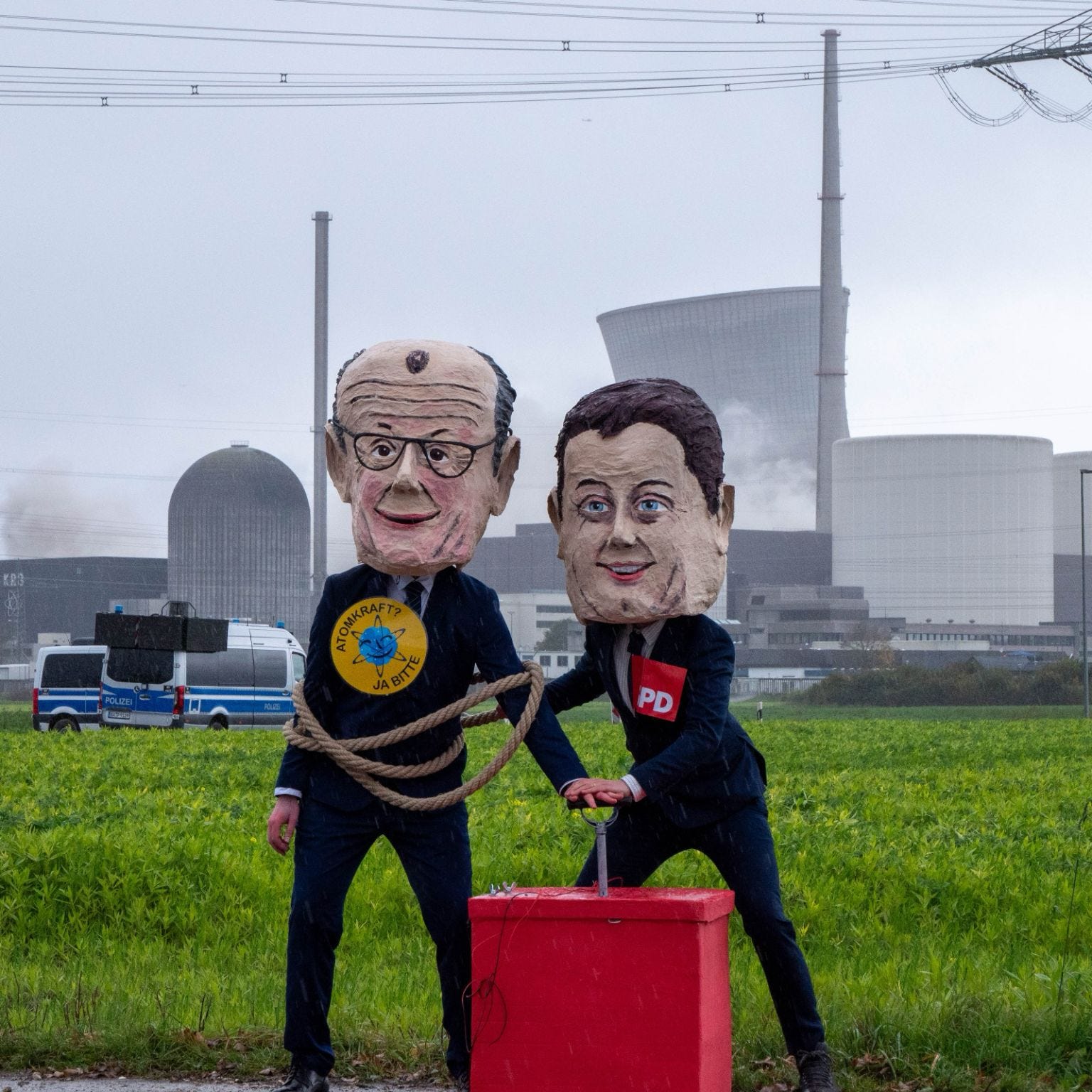
Earlier this month, when the cooling towers at the Gundremmingen nuclear power plant were demolished, the media declared yet again that the nuclear era in Germany had come to an end. “Again?”, wondered anyone following events closely, as the same thing was said in April two years ago when the last plants went offline, and again in spring when the towers in Grafenrheinfeld were blown up. In truth, apart from media-friendly spectacles like cooling-tower demolition, the topic of nuclear power has become rather quiet in Germany. Within the governing coalition, an unspoken non-aggression pact seems to be in place, and as pro-nuclear activists satirised in Gundremmingen, the otherwise open-minded Chancellor appears politically bound and gagged by his coalition partners: “Nobody says the N-word!”
Meanwhile, the national debate prefers to orbit around the “cityscapes”, cultural flashpoints and symbolic fights. Every week seems to bring a fresh distraction. The actual engine of prosperity, a functioning energy system, receives far less attention. So far, the public seems to play along, but much suggests that this won’t last.
Prosperity is transformed energy. Without abundant, affordable energy, we could not have built our past prosperity, and without it we cannot sustain it in the future. More and more countries around us understand this and are turning to nuclear power as part of a low-carbon energy transition. Leaving aside commissioned studies from the German Energiewende lobby, the scientific consensus is clear: energy systems that include a substantial share of nuclear are far cheaper than systems relying solely on renewables.
What the anti-nuclear movement still imagines as “gentle energies” comes in practice with immense resource and land demands, and adds enormous complexity. Turning weather-dependent energy harvesting into a reliable power supply for an industrial society is anything but trivial, and pushes costs ever higher. The truly gentle energy source is nuclear power, with its minimal land and resource use and its high reliability.
But the comparison is not merely theoretical. For now, coal plants are running in place of nuclear. The price we all pay, not only in money, is enormous. Two days before the Gundremmingen towers fell, WePlanet and the California-based Anthropocene Institute released a new report (I am co-author) on the costs so far of Germany’s nuclear exit. The figures are shocking but consistent with the magnitude of previous analyses:
Between 2011, when the first reactors were shut down, and 2023, the additional coal burning required to compensate resulted in roughly 19,200 premature deaths due to air pollution. That is nearly five times higher than even the most pessimistic WHO estimates of fatalities from the Chernobyl disaster.
Those health impacts include around 177,000 severe and more than 10 million mild illnesses.
The financial burden is staggering as well: the extra emissions certificates required under the EU ETS cost around 57 billion euros, not counting further economic losses such as sick days.
Finally, around 800 terawatt hours of CO₂-free electricity were lost and replaced by fossil generation, producing 730 million tonnes of CO₂—more than Germany’s total greenhouse gas emissions in 2024.
Our report ends in 2023, and since then nearly two additional years of avoidable coal burning have passed. The death toll now likely exceeds 20,000, and ETS costs over 60 billion euros. These figures will keep climbing as long as coal plants continue to operate. For comparison: in 2010, the year before the phase-out began, German nuclear plants generated 133 TWh of electricity. In 2024, coal produced 97 TWh. Had we kept nuclear running and phased out coal instead, the coal exit could already be complete today, and our gas dependence dramatically lower.
As things stand, none of this is likely to change soon. Coal plants are running. The economic crisis may deepen or perhaps temporarily ease—maybe peace will come to Ukraine, maybe the US will adjust its trade policy. Either would help our economy, thereby buying us some time. But the structural problem underlying everything remains: without sound energy policy, there can be no successful economic policy (nor meaningful environmental policy). The desire to regain economic strength cannot be reconciled with a dogmatic energy doctrine. Decarbonising the energy system requires grounding policy in economic realities, pragmatism and facts.
Sooner or later, excuses and distractions will run out. As Kurt Tucholsky noted, “The people misunderstand most things, but they feel most things correctly”—and the feeling that this cannot continue is palpable across the country. At the same time, decarbonising energy will remain a task for decades, driven by climate change, international commitments, competitiveness and public health.
The shutdown of the last nuclear plants in April 2023 and the demolition of their towers increasingly look like monuments to a failed path—a low point in post-war German history, a high mass of irrationality and collective self-harm. They will not prove to be the end of an era. The current silence in public debate is deceptive and may soon prove to be the calm before the storm. The only question is how much more pain must accrue.
Niels-Arne Münch is Senior Political Advisor at WePlanet and co-author of the new report “Germany’s Nuclear Phase-Out: The True Costs for People, Climate and the Economy”.